“Overall, about one-in-five Muslims in Egypt (18%) describe
non-Muslims as not too free or not at all free to practice their
religion. However, Egyptian Muslims are not necessarily troubled by
this perceived lack of religious freedom: Two-thirds of those who say
non-Muslims in Egypt are not too free or not all free to practice
their faith say this is a good thing.” [6]
From Table 5 we can
also see that among respondents who said that people of other
religions were at least somewhat free to practice their religion,
(.05 + .06) / .6248, or 17.6% (roughly), said that this was a bad thing.
Only 4% of
Egyptian Muslims overall said that it is a bad thing that people of
other religions are not too free or not at all free to practice their
religion. If we add that 4% to the 47% who supported the idea of
people of other religions being at least somewhat free, we get about
51% of Egyptian Muslims seemingly supportive of people of other
religions being at least somewhat free to practice their religion.
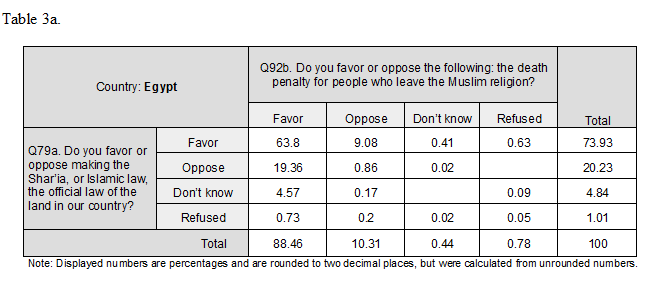
The 2013 Pew Research study at the center of this controversy
reports that 88% of Egyptian Muslims support the death penalty for
people who leave Islam (p. 219, Complete Report). That happens to be
close to what Maher claimed. His critics who claimed that the actual
Pew figure in question was 64% were mistaken. In many cases his critics
were relying on an erroneous secondary source from the popular media
instead of reading the original Pew source with due diligence.
Those who claimed that 75% (or more) of Egyptian Muslims supported
religious freedom seem to have not read or have misread the Pew
(2013) report, which shows that only 24% of Egyptian Muslims overall
responded that people of other religions in their country were very
free to practice their faith and that this was a good thing (p. 173,
Complete Report). Pew used the “very free—good thing” response
combination as its measure of support for religious freedom for
people of other religions (e.g., see p. 63, Complete Report). I also
considered a different measure that included “somewhat free”: At
most, about 47% to 51% of Egyptian Muslims overall supported
religious freedom for people of other religions, assuming that being
at least “somewhat free” is considered an adequate level of
freedom. But when we use opposition to the death penalty for apostasy as our measure,
only about 10% of Egyptian Muslims support religious freedom.
In Part 2, I will examine and present data bearing on the more
general question debated by Maher and his guests in the Oct. 3, 2014
episode of Real Time, namely, what percentage and numbers of Muslims
overall hold fundamentalist views that are contrary to human rights?
I will also explore some possible reasons why some respondents
opposed sharia as the official law of their country but favored some
particularly harsh elements of sharia such the death penalty for
apostasy, stoning for adultery, or corporal punishment such as
whipping and cutting off of hands.
Pew Research is not responsible for my
analyses or interpretation of this data. From the Pew instructions
for downloading data sets: “All manuscripts, articles, books, and
other papers and publications using our data should reference the Pew
Research Center’s Religion & Public Life Project as the source
of the data and should acknowledge that the Pew Research Center bears
no responsibility for the interpretations presented or conclusions
reached based on analysis of the data.”
References and Notes
[1] HBO: Real Time with Bill Maher,
Episode 331, October 3, 2014
Maher's guests in that heated
discussion were Ben Affleck, Sam Harris, Nicholas Kristof, and
Michael Steele. [Update: I provide a
transcription of their debate
here.]
[2] Maher's claim, as I heard it, about
8:00 into the above [1] clip: “I can show you a Pew poll of
Egyptians—they are not outliers in the Muslim world—that say like
90% of them believe that death is the appropriate response to leaving
the religion.” Out of context, his use of the term “Egyptians”
is too general, because the study in question reported on the results
for Egyptian Muslims. In context, I believe Maher was referring to
Egyptian Muslims.
Which Pew survey Maher was referring
to is not entirely clear, though “90%” is more consistent with
the 2013 Complete Report, p. 219. *[But see May 17, 2015 update, below]. Maher made a similar statement in
an
interview (posted on Real Clear Politics on September 10, 2014)
on PBS with Charlie Rose, but said “over 80%.” From about 1:22 in
the linked
clip,
Maher tells Rose, “There's a Pew poll of Egypt done a few years
ago. 82% I think it was, said stoning is the appropriate punishment
for adultery. Over 80% thought death was the appropriate punishment
for leaving the Muslim religion.” Maher's phrasing “leaving the
Muslim religion” matches the phrasing used on p. 219 of the (2013)
Complete Report, but also matches the phrasing in the 2010 report (p.
35, and throughout the text, 2010b). For stoning of adulterers,
Maher's mention of “82%” support is matched in the
2010 report (p. 35, 2010b), whereas the 2013 report has 81% for the
sharia-supporting subset (p. 54) and 80% overall (p. 221).
In a more recent interview (December
4, 2014) with Sally Kohn of Vanity Fair, Maher was
quoted,
in response to a question about distinguishing between “radical”
and “moderate” Islam, as follows:
“But as far as
your basic question, this is something that is perhaps not
controversial if you delve into the statistics—and there are
statistics. There’s lots of polling and there’s lots of research
on this subject that connects, lets call them the rank-and-file, with
the extremely illiberal ideas of Islam. Like, if you leave the
religion, it is the appropriate response to have death visited upon
you. That’s not an outlier in the religion. A
Pew poll of Egypt done a few years ago said, I think, 90 percent
of Egyptians felt that if you leave the religion, that’s the
appropriate response.”
The link in the article goes to the
original uncorrected version of Fisher's (May 1, 2013) Washington
Post article, not the Pew (2013) study.
*Update (May 17, 2015). A more recent comment (May 15, 2015), wherein Maher cites other specific numbers for opinions on adultery and apostasy punishments, indicates that he may have derived his "like 90%" from the 86% support for death for apostasy among the sharia-favoring subset data on page 55. It appears that Maher, like many others, thought the subset data were general sample data. I discuss his recent comment
here.
[3] The World’s Muslims: Religion,
Politics and Society, Pew Research Center (April 30, 2013)
I'll call this the Main Report, to
distinguish it from the Complete Report. A key difference between the
two is that the Complete Report contains “Appendix D: Topline,”
whereas the Main Report does not.
(The Main Report's “
Appendix C: Survey Methodology” does contain an explicit reference and link to
“Appendix D,” where it says “The survey questionnaire and a
topline with full results for the 24 countries surveyed in 2011-2012
is included in
Appendix D (PDF).”). Nevertheless, the Overview of the
Main Report tells the reader where to find the full results, and
provides a link. Under the bold heading “About the Report,” it is
stated that “These and other findings are discussed in more detail
in the remainder of this report...The survey questionnaire and a
topline with full results are available as a
PDF,”
and the link is given to the Topline Questionnaire (April 29, 2013),
which has the same material as “Appendix D: Topline” of the
Complete Report, including the Q92b results on p. 219. From the front
Overview page of the Main Report, one can access the Complete Report
and other documents on the right hand side near the top of the page
under the heading “Report Materials.” In the Complete Report on
page 37, under the heading “About the Report,” the Pew authors
tell the reader that “The survey questionnaire and a topline with
full results are available on page 159.”
The (2013) report also includes data
from an earlier Pew study of sub-Saharan African countries, titled
Tolerance and Tension: Islam and Christianity in Sub-Saharan
Africa (April, 2010).
http://www.pewresearch.org/wp-content/uploads/sites/7/2010/04/sub-saharan-africa-full-report.pdf (I cite this study as 2010a)
[5] Topline
Questionnaire. Survey Topline Results. The World’s
Muslims: Religion, Politics and Society. Pew Research Center
(April 29 or 30, 2013).
[6] Neha
Sahgal and Brian Grim (July 2, 2013). Egypt’s
restrictions on religion coincide with lack of religious tolerance.
Pew Research Center, Fact Tank
[7] Pew Research Center Global
Attitudes Project: Muslim Publics Divided on Hamas and Hezbollah
(December 2, 2010)
(I cite this study as 2010b).
[8]
Data
Set (for the 2013 Pew report). The World's Muslims Data Set
(Published June 4, 2014).
Source: Pew Research Center’s Religion & Public Life Project.
Retrieved October 19, 2014.
The Pew (2013) Data Set is freely
available upon request within some limits and conditions.
Note that the Data Set folder contains
some pdf files with additional written information about the study,
particularly concerning methodological aspects. Of particular
interest, the quoted instructions for Q92b (apostasy) are from page
37 of 48, in a pdf file titled Pew Research Center Religion and
Public Life Project. The World's Muslims Questionnaire. That file
is one of several that come with the Data Set download.
In addition, I accessed the Data Set
for Tolerance and Tension: Islam and Christianity in Sub-Saharan
Africa (April 15, 2010).
Note that some of these data are
reported in Pew's (2013) report, such as the apostasy data on p. 219.
[9]
For those who wish to analyze and then report results from Pew's data
file, I recommend that only those who have training in statistics and
relevant scientific research methods attempt to do so. Those who
don't have such training should seek to collaborate with and obtain
guidance from those who do. Please see Pew's Instructions
for Downloading Data Sets for more information. That said, the
data file is available for anyone who wants to explore it, within
some limits and conditions [8]. The data can be analyzed using IBM
SPSS, or the open source freely-available (but very basic) PSPP,
or other major statistical packages that can read SPSS .sav files. I
provide instructions for doing a basic analysis of the Pew (2013)
apostasy data here.
[10]
According to Pew: “Data were weighted to account for
differences in probability of selection. Additionally, in some cases
survey results were weighted to match the demographic characteristics
of the population in each country.” Source: Background and
Codebook, Pew Research Center, World’s Muslims Data Set, Survey
Conducted Oct. 2011 – Nov. 2012. This file is one of several
that comes with the Data Set [8] folder.
[11]
Max Fisher (May 1, 2013). 64 percent of Muslims in Egypt
and Pakistan support the death penalty for leaving Islam.
Washington Post. (Original uncorrected version, as viewed December
10, 2014. To switch to the partly corrected version, add a forward
slash to the end of the URL. Note that either version could be
changed).
[12]
Max Fisher (May 2, 2013). What the
Muslim world believes, on everything from alcohol to honor killings,
in 8 maps, 5 charts.
Washington Post. (Uncorrected).
[13] Max Fisher (May 1, 2013).
Majorities of Muslims in Egypt and Pakistan support the death
penalty for leaving Islam. Washington Post. (Partially corrected
version, as viewed December 10, 2014. To go to the uncorrected
version, remove the forward slash from the end of the URL. Article
could be changed).
[14] Christopher Ingraham (October 6,
2014). Ben Affleck and Bill Maher are both wrong about Islamic
fundamentalism. Washington Post. (Subsequently corrected).
[15] Shadi
Hamid. Temptations of Power: Islamists and Illiberal
Democracy in a New Middle East
(2014). New York. Oxford University Press.
(e.g., see p. 57).
(My
transcription).
[18] Some
example usages of “one-in six”:
“In 2012, one in six (15%) adults
exhibited signs of a possible psychiatric disorder...”
“...about one in six use IM (16%) and
video conferencing (15%) applications.”
“Only one in six (16%) describe
themselves as 'old'...”
“...about one in six, or 17.2
percent...”
“About one in six respondents (18%)
would like to reject coal altogether.”
[19] Reza Aslan with Thom
Hartmann (October 20, 2014; posted Oct. 21, 2014). Conversations
w/Great Minds P1: Dr. Reza Aslan - What Do Atheism & Islam Have
in Common? The Big Picture.
Russia Today.
(My transcription).
Also see
this
link if there are problems with the one above.
[20] Laws Criminalizing Apostasy.
Library of Congress. Viewed November 17, 2014.
[21] Among
Pakistani Muslims, 75% said their country's blasphemy laws were
necessary to protect Islam, while only 6% said those laws unfairly
target minorities, about 1% said neither/both equally (VOL), 17% said
they didn't know, and about 1% refused to answer (source: Data Set
[8]; also see p. 199 of the Complete Report, 2013). Pakistan was
apparently the only country wherein the blasphemy question (Q76) was
asked in the Pew (2013) study. An alternative measure of a minimum
level of support for religious freedom in Pakistan would be the
percentage of Muslim respondents there who oppose both the apostasy
death penalty and their country's blasphemy laws, which include the
death penalty and life imprisonment. As the cross-tabulation of Q76
and Q92b in Table 6 shows, only about 1.6% seem to oppose both. That's
assuming that, for these respondents and given the two main explicit
response options (needed to protect Islam vs unfairly target minority
communities), those who say the blasphemy laws “unfairly target
minority communities” (p. 199, Complete Report) show a kind of
opposition to those laws, and hence possible support for religious
freedom.

Appendix I
Would a reasonable reader have known,
or have good reasons to believe—without asking Pew or checking the
numbers in the data file—that the data on p. 219 of Pew's (2013)
Complete Report were of the general samples of Muslims? Here I will
discuss some of the pieces of evidence that suggest that the answer
to that question is 'yes.' The 2013 report is about Muslims' beliefs,
so the default assumption is that when the authors refer to Muslims
of a particular country, explicitly or through contextual or other
implication, and don't mention or imply a subset of Muslims (e.g.,
those who favor sharia), they are referring to the general sample of
Muslims for a country. The researchers tell us in the report when
they are dealing with a subset. For example, on p. 55 of the Complete
Report the results for the subset of Muslims who supported sharia are
shown and described as such. On p. 202, we see that Q81 was asked of
those who favored sharia in response to Q79a. In comparison, in the
table on p. 219, there are no indications that the apostasy question
Q92b was only asked of a subset of Muslims. Likewise, for the sharia
question Q79a on p. 201, there are no indications that it was asked
only of a subset, and p. 46 is clear enough that Q79a was asked of
the general sample of Muslims. Note the consistency of presentation
between Q79a on p. 201 and Q92b on p. 219: neither is preceded by a
note referring to a limit or condition on who should be asked the
question.
Another piece of evidence comes from
the consistency in the presentation of the data in the table for
Q92b, p. 219, of the Complete Report. The table includes data from an
earlier study. These are from the general samples of Muslims in each sub-Saharan African country surveyed. The table includes not only the
2011-2012 data, but also the 2008-2009 data from sub-Saharan African
countries presented in
a
2010 report (2010a). These earlier data are clearly described as
from the general sample of Muslims. On p. 50 (or p. 58 of 331) for
apostasy, “leaving the Muslim religion,” the figure for Q95c is
labeled “Based on Muslims,” as is the table for Q95c on p. 291
(p. 298 of 331) which gives the instructions to the interviewer and
the wording of the question: “ASK IF MUSLIM Q95 And do you favor
or oppose the following? ... c. the death penalty for people who
leave the Muslim religion.” Also see p. 291 (or p. 221 of 254 of
the
Topline, 2010a). The only condition mentioned was that the
respondent be a Muslim. Note that Q95c (2010a) in the sub-Saharan
African study is the same as Q92b for the other countries in the 2013
study.
In the 2013 report, these summaries
for the sub-Saharan African countries are in the same columns as the
more recent data including Egypt, Pakistan, Indonesia, etc. This is a
crucial point. The researchers would not have put the data from these
two different sets in the same columns unless they were all of the
same kind for each country in that table. Otherwise, they would note
the differences. The only difference noted is that the data from the sub-Saharan African countries (except Niger) were collected at an
earlier time (2008-2009) than the 2011-2012 data. Regional
limitations in the survey are noted for Thailand, but the apostasy
question was still asked of all the Muslims who were surveyed within
those regions.
The percentages on page 219 of the
(2013) Complete Report clearly differ overall from the percentages,
for example, on page 55. As one might expect, support for the death
penalty for apostasy tends to be higher among Muslims who support
sharia as the official law of their country. Egypt and Jordan are the
exceptions, where the percentage of support for the death penalty for
apostasy is higher in the general sample than it is among those who
favor official sharia (as described in Q79a). In the case of
Afghanistan, the level (rounded off as reported) is the same between
the general sample and the sharia-supporting subset.
Pew's (2013) results for Muslims
favoring death for apostasy in Egypt (88%), Jordan (83%), and
Pakistan (75%) are consistent with those obtained in an earlier
survey from general samples of Egyptian (84%), Jordanian (86%), and
Pakistani (76%) Muslims (Pew,
2010b).[7]
The Data Set [8] files were made
available to members of the general public for downloading June 4,
2014.* In at least one explanatory pdf document that comes with the
Data Set, the questions are presented with instructions for the
interviewer. For Q92b, the apostasy question, the instructions are as
follows [brackets and parentheses in original]:
“ASK IF MUSLIM
IN ALL COUNTRIES EXCEPT IRAN, MOROCCO AND UZBEKISTAN Q92 Do you favor
or oppose the following? (READ LIST)
a. giving [In
Turkey: Muslim leaders such as Imams, Hodjas and Sheiks; In all other
countries: Muslim leaders and religious judges] the power to decide
family and property disputes [In Russia: In the Muslim Republics of
Russia; In Thailand: In the provinces where the Muslim population
forms a majority]
b. the death
penalty for people who leave the Muslim religion
c. punishments
like whippings and cutting off of hands for crimes like theft and
robbery
d. stoning people
who commit adultery
1 Favor
2 Oppose
8 Don’t know (DO
NOT READ)
9 Refused (DO NOT
READ)”
Pew sources for the above: [8], [10].
The above instructions indicate that
the Q92 set (a, b, c, and d) was asked if the respondent was a
Muslim. Three countries are excluded, and variations on the wording
of Q92a are given for three others, but Q92b pertaining to apostasy
is the same for all Muslims asked. Likewise, for Q92c and Q92d. Aside
from three excluded countries, all Muslims respondents in the
countries listed on p. 219 of the Complete Report, were asked Q92b,
c, and d. There is no condition added where the Q92 set could only be
asked if a respondent had given a specific answer on a previous
question. This means that those who claim the apostasy question was
only asked of those who answered that they favored sharia (answered
favor to Q79a) are wrong.
*Note that while the Data Set and
accompanying files were not directly available to the public until
June of 2014, they were at least available for those who commented on
the Pew (2013) results in response to the Maher-Affleck controversy
in October of 2014.
Appendix II
In response to my request for
verification of my understanding of the apostasy numbers on p. 219 of
the Complete Report (or p. 219 of the Topline Questionnaire, which
has the same numbers), Dr. Bell, the primary researcher of the 2013
Pew study, on October 22 (2014) wrote:
At the request of the author of
Uncertainty Blog I obtained from Dr. Bell permission to quote and photo the
message above, with specific contact information cut out at Dr.
Bell's request.
Appendix III
This section gives a chronological
summary of my attempts to get various sources to correct their
erroneous presentation of Pew's (2013) apostasy numbers. After
October 11 (2014), I became aware that the error had already become
much more widespread than I'd realized initially. On October 15, I
was finally able to address what appeared to be a main source of the
error.
Early May, or
possibly on April 30, 2013. I emailed Sam Harris to correct him re
his tweet of the erroneous “64%” figure for Egypt, and provided
the reference to page 219 of the Pew report.
Result: I don't
know. (No reply to initial email). [Update: Harris cited the correct apostasy number (88%) in a
blog post, September 28, 2015, linking to my brief
guest article version of the above fact-check. In August of 2015, I had emailed Harris with the correction again, after he issued an open
invitation for readers to help him "correct every factual error" he'd ever made. Whether Harris' correct report and link to my guest article resulted from my email, I don't know].
October 9, 2014.
Commented to correct author of Uncertainty Blog re “64%” for
Egypt.
Result: The figure
was corrected, then uncorrected, then later corrected again on about
October 18, 2014.
October 11, 2014.
Notified an editor of Bloomberg View, regarding an article titled
In
Affleck Versus Maher, Everyone Loses (Oct 7, 2014) by
Ramesh
Ponnuru, where the author makes the 64% error for Egypt in
attempting to correct Maher. In my email I cited p. 219 and provided
a link to the Complete Report.
Result: An editor
at Bloomberg View replied the next day, saying he would contact a
director at Pew for clarification. Corrected to 88% sometime shortly
thereafter.
October 15, 2014.
Notified Washington Post re errors on apostasy data in Max Fisher (re
May 1, 2013, and May 2, 2013) articles, and provided Complete Report
link and page 219 reference.
Result: On or
about Oct. 28 or 29, for the Fisher (May 1, 2013) article, they
corrected the apostasy figure for Egypt from 64% to 88%, removed the
red bar plot, introduced new error for Pakistan apostasy figure
(62%), several old errors remain.
October 17, 2014.
Notified
Max
Fisher of his erroneous apostasy numbers,
provided Complete Report link and page 219 reference.
Result: I don't
know. (No reply).
October 18, 2014.
Contacted Primary Researcher of the study in question at Pew for
verification of the apostasy numbers on p. 219 and described problem
with Washington Post article. I cited Egypt as an example.
Result: Received
reply on October 22 confirming that I was correct re the 88% figure
for Egyptian Muslims overall and the data on p. 219 are indeed for
the general samples. (Also see October 29, below).
October 19, 2014.
Obtained the Data Set for the 2013 Pew report, began to analyze it.
Result: Confirmed
the percentages on p. 219 (general sample) and p. 55
(sharia-supporting subset) of the Pew (2013) report.
October 27, 2014.
Notified the Washington Post regarding their errors for Pew's
apostasy and adultery data in article by Christopher Ingraham (Oct.
6, 2014), provided link to Complete Report and pp. 219 and 221. I
told them that I'd confirmed with Pew.
Result: Correction
was made subsequently, though I don't know when exactly, or whether
this was related to my notification to them. (Checked December 10,
2014).
October 27, 2014.
Notified Christopher Ingraham of his error, provided in email message
history the same information given in my notification to the
Washington Post.
Result: No reply,
but see above. Correction made.
October 29-31,
2014. Re Fisher, May 1 2013 article, apostasy data. Notified the
Washington Post expressing appreciation for their correction of the
figure for Egypt, but also informing them of their new error for
Pakistan, and the other errors that remained in the text of the
article.
Result: Except for
the 88% for Egyptian Muslims, several errors remain. I had a brief
exchange via email with an editor, in which I again cited p. 219 of
Pew's 2013 Complete Report and told them I'd confirmed with Pew, but
this was to no avail. Not fully corrected as of January 20, 2015.
December 1, 2014.
Notified Washington Post of the erroneous claim that “more than
75%” of Egyptian Muslims supported religious freedom in the Fisher
(May 1, 2013) article; provided link to Complete Report, page
references, and explanation.
Result: Not
corrected as of January 20, 2015.
Appendix IV
Here is a small non-scientific
sampling of writers who mistakenly spread the 64% error, or other
errors related to apostasy or religious freedom or the Pew data. If
one searches in a web browser the key word combinations such as
“Egypt,” “64%,” “Muslims,” “leaving Islam,” etc., a
very large number of examples come up. Some examples link to or cite
the original Washington Post (May 1, 2013) article, while others
don't. Some tried to correct Maher by using the 64% figure, with or
without reference to the Washington Post (May 1, 2013) article. I
checked these sources again on December 12, 2014, or later. Note that
any of these examples may be changed later by their authors or
editors. I've categorized the errors. [I invite any of the authors listed below who've subsequently corrected their numbers to please notify me and I will note the corrections here].
1. Persuaded, by people purporting to
correct them, into relaying incorrect apostasy figure(s).
Sam Harris,
tweet,
April 30, 2013, 7:03 pm. Note that this 64% error occurred before the
WP article. [In an article on September 15, 2015, Harris cited correct figures by
linking to my guest article fact check at Uncertainty Blog].
2. Relayed the incorrect apostasy
numbers directly or indirectly from the Washington Post.
Daniel Dennett,
Facebook
post, May 1, 2013, from a
GSHM
(Global Secular Humanist Movement) citation of Fisher's Washington
Post article, May 1, 2013.
Allahpundit,
Hot
Air article, May 1, 2013. (Also includes the false claim that in
the Pew (2013) study “Only those Muslims who first said that they
support sharia law were asked whether apostates should be executed”).
"In Egypt and
Pakistan, 64 percent support executing for apostasy.” Source cited
is the WP article by Max Fisher (May 1, 2013).
Ali A. Rizvi,
blog
article, Huffington Post, October 6, 2014.
For the apostasy
data, Rizvi includes a correct link to the Pew (2013) Complete
Report, but also a link to the Washington Post (May 1, 2013) article.
On January 16, 2015, in an article for CNN, Rizvi
quoted
the partially corrected Washington Post (May 1, 2013) Fisher article,
incorrectly claiming that the Pew (2013) study showed that 62% of
Pakistani Muslims support death for apostasy.
Razib Khan,
blog
post, Gene Expression Blog, October 7, 2014.
Used the
Washington Post's incorrect apostasy numbers from the original
uncorrected Christopher Ingraham (October 6, 2014) Washington Post
article. Khan discussed the Affleck vs. Maher/Harris incident and
tried to get an estimate of the numbers and percentages of Muslims
overall who supported death for apostasy.
Richard Dawkins,
retweet,
October 9, 2014.
Where Maher is
quoted referring to the “Pew poll” that he claims showed “90
percent of Egyptians” support the death penalty for apostasy, a
link to the original uncorrected Washington Post (May 1, 2013)
article is inserted instead of a link to the Pew study.
Years later, the errors continue...
PragerU,
video, "Where are the Moderate Muslims?" April 27, 2017.
At 1:44, the narrator says that according to Pew "62%" of Pakistani Muslims favored the death penalty for apostasy. The error appears to be based on the above-noted Washington Post attempted correction of their May 1, 2013 article.
Apostate Prophet,
video, "The Death Penalty for Leaving Islam," July 12, 2019.
The narrator cites Pew and says that, among Muslims who think Islam should be the law of the state, 6 of 10 Pakistani Muslims (1:47) support the death penalty for apostasy. This error appears to be based, again, on the erroneous Washington Post (May 1, 2013) article or the attempted correction of it.
3. Attempted to correct Maher by using
[or while citing] the Fisher WP (May 1, 2013) article, misrepresented Pew data.
Omar Baddar,
article,
Huffington Post, May 13, 2014.
In response to
Maher's comments made in the spring of 2014 mentioning the Pew
apostasy figures for Egypt, Baddar linked to the Washington Post (May
1, 2013) article and
wrote:
“Bill Maher attempted to cite an Egypt poll, saying it showed that
80-90% of people in the country approved of death as a punishment for
leaving Islam. The
actual
number is 64%, which is still horrifyingly high, and I am alarmed
by it.”
Rossalyn Warren,
article,
Buzzfeed, October 6, 2014.
Tries to correct
Maher's statement (from Oct. 3, 2014) by citing the Washington Post
(May 1, 2013) article: “In fact, the poll he is referring to states
that in both Egypt and Pakistan
64%
hold this view, not 90%.”
Cenk Uygur,
video
presentation/talk, The Young Turks, published October 6, 2014.
Uygur responds to
Maher's and Harris' (October 3, 2014, HBO: Real Time with Bill
Maher) citation of polls. In a section beginning at about 10:52
in the clip, Uygur makes the usual mistake of confusing the Pew data
with the erroneous Washington Post/ Fisher numbers. Uygur said
“This,” while looking at a paper and setting up for displaying
the red bar plot, “comes from Pew Research Center,” and the
“Washington Post wrote an article about it.” But he doesn't tell
viewers that the numbers, the red bar plot, and the descriptive title
of the red bar plot that he shows and reads from to counter Maher come
from Fisher's Washington Post (May 1, 2013) article.
When Fisher's red bar plot is on the screen from approximately 11:04
to 11:50, Uygur is talking about the numbers, and the source for the
plot is labeled falsely by The Young Turks as “Pew Research
Center.” Fisher's labeling of the source as “Pew” is also
visible at the bottom of the plot.
10:52 Uygur [my
brackets]: “Now there are polls that are really troubling, which
they mention later. And here, let me show you one. Okay. And this
[10:58, touching a paper] comes from Pew Research Center. Washington
Post wrote an article about it. Share of Muslims who support the
death penalty for leaving Islam. [11:04, the red bar plot is first
shown on the screen] Okay. Now, when you look at some of the
countries down at the bottom there or at the top, however you want to
look at it, Afghanistan's over 60%, Pakistan is right around 60% as
well, Egypt—uh, so those are really really troubling. When you look
at the other end though, almost no one in Kazakhstan thinks that, or
Albania, or Turkey, or Kosovo, and the list goes on and on.”[11:25]
13:30 Uygur says
of Indonesian Muslims that “a disturbing number, a little over 10%
say that apostates should be executed,” while, he says, “closer
to 90%” of them say people “should not” be killed for apostasy.
According to Pew (2013), 16% favored and 77% opposed the penalty, see
p. 219.
15:34 Uygur
comments directly on Maher's “90%” figure for Egypt: “And as we
just showed you the numbers he's referring to, he actually got it
wrong, it's actually a little over 60% of Egyptians believe that,
which is still a very disturbing number, but it's not 90%.” Uygur
attempts to use the Washington Post/ Fisher numbers to correct
Maher's claim about Pew's numbers.
Nida Khan,
article,
Huffington Post, October 14, 2014.
Responding to
Maher's recent Islam controversy, Khan
wrote
that his “90%” figure was wrong, and that the “actual figure
was 64%.” She linked to the Pew (April 30, 2013) study, but cited
and relayed some of the Washington Post's (May 1, 2013) erroneous
apostasy and religious freedom numbers.
John Sexton,
blog
article, Breitbart, October 14, 2014. [Update: See John Sexton's note Feb. 21, 2015,
here]
Refers, cites, and
links to Fisher's (May 1, 2013) Washington Post article, and links to
Pew's (2013) Complete Report, but proceeds to make the same error as
Fisher, and says that Maher's claims about Pew's apostasy numbers for
Egypt (variously, “90%” or “over 80%”) are wrong.
4. Attempted to
correct Maher with 64% figure, but didn't mention the WP (May 1,
2013) article.
Ramesh Ponnuru,
article,
iPolitics, October 8, 2014. (Published in many venues).
Ponnuru
cites and links to the Pew (2013) study, but uses the 64% apostasy
number for Egypt to correct Maher: “Maher overstated his point: It
isn’t true, as he asserted, that 90 per cent of Egyptians support
the death penalty for leaving Islam. But the true number—64 per
cent according to a Pew
Research Center
poll—is bad enough.” Ponnuru also cited the Ingraham
Washington Post (October 6, 2014) article earlier in the piece.
Waleed S. Ahmed,
article,
Muslim Matters, October 9, 2014.
To refute Maher,
Ahmed includes a link to the Pew (2013) Complete Report. He falsely
claims that the Pew report “...offers no direct statistics on
Muslims who support capital punishment for apostasy.” He apparently
did not read p. 219 of the report to which he linked. He writes
regarding those “direct statistics” that “...even
if they were to be extrapolated (which introduces an error), the
support would be at 64% – not the 90% he so forcefully claimed.
Maher also fails to mention the significant disparity Egypt has with
other Muslim majority countries on this issue: Indonesia (13%),
Lebanon (13%), Tunisia (16%) and Turkey (2%).” (parentheses in
original).
Ahmed doesn't cite the Fisher (May 1, 2013) article, but it is
interesting to note the similar phrasing.
Ahmed
Benchemsi, article,
Salon, October 13, 2014.
Benchemsi claimed that the Pew (2013) survey was unreliable. He
alleged that respondents were not free to give honest answers due to
fear of repercussions. In attempting to correct Maher's “90%”
claim, he linked to Chapter 1 of the Pew (2013) report. He apparently
used the 86% and 74% figures from Chapter 1 to obtain 64% in order to
“correct” Maher. He also linked to the Topline Questionnaire pdf
and cited it in an attempt to support a different allegation against
the researchers, but apparently didn't reach p. 219 that has the
apostasy data.
Omar Sarwar,
article,
Huffington Post, November 6, 2014.
Sarwar linked to
Pew's (2013) Complete Report when he wrote: “While jousting with
Affleck, Maher
cited
the Pew Research Center's 2013
The World's Muslims report,
declaring that 90% of Egyptians believe that apostasy should be
punishable by death. In fact, the report shows that 64% of Egypt's
Muslims hold this view.” [Update: Sarwar's article contains a correction with the 88% figure. The correction was made some time after February 21, 2015]
5. Attempted to support Maher using
erroneous apostasy figures from the Washington Post.
Dustin Siggins,
article,
Daily Caller, October 8, 2014
Siggins cited the
Pew (2013) survey and the then-uncorrected Washington Post article by
Ingraham (October 6, 2014) for erroneous apostasy figures, and even
quoted some of them incorrectly from Ingraham.
6. Erroneous 64% figure is given, but
no source is mentioned.
Kashif
Chaudhry, blog
article, The Express Tribune, October 17, 2014.
Chaudary doesn't directly accuse Maher of having the wrong numbers.
He cites the 64% figure for Egyptian Muslims and a couple of other
figures that are consistent with the Washington Post's (May 1, 2013)
apostasy numbers but provides in the article no mention of or direct
references to sources for them.
7. False claim made
that only Muslims who favored official sharia were asked the apostasy
question.
Wikipedia,
article on apostasy, as it appeared January 19, 2015.
Note that
Wikipedia refers to the Pew (2013) report as the “2012 Pew Survey,”
and links to the Main Report, which opens to show Chapter 1 and on
the right hand side the “Report materials” including the Complete
Report and the Topline Questionnaire, which they apparently ignored.
“
The support for a death penalty
among all Muslims in those countries is unclear from 2012 Pew
survey,[115]
which surveyed support for death penalty only among those Muslims who
favor Sharia as the official law of the land. The exact percentage is
also unclear from this survey, as it does not include Muslims who may
favor a death penalty for apostasy yet do not favor Sharia as law of
the land.”
[Update, February 13, 2017. After a comment by a reader, I noticed that Wikipedia has removed their explicit claim that only those who favored sharia were asked the apostasy question, but their description and presentation still makes no mention of the general sample data on page 219 of Pew's full report. They still extrapolate the apostasy numbers (see "Group C") incorrectly, apparently based on Pew's reported sharia-favoring subset apostasy data, though they at least admit that those extrapolated numbers are theirs and not Pew's.]
8. Erroneous description of Pew's
religious freedom data.
Dan Merica,
blog
article, CNN Religion Blogs, April 30, 2013.
Merica mistakes
the percentage of a subset of Muslims for the percentage of Muslims
overall:
“Despite
views that Islam should influence politics and law, an overwhelming
number of Muslims told Pew that religious freedom was a good thing.
Ninety-seven
percent of Muslims in South Asia, 95% in Eastern Europe, 94% in
sub-Saharan Africa and 85% in the Middle East and North Africa
responded positively to religious freedom, according to the poll.”
The numbers Merica cites come from the Overview of Pew's (2013) report (e.g., see Complete Report, p. 32). However, Pew describes those results as taken from a subset of Muslims:
“The survey also
asked Muslims whether people of other faiths in their country are
very free, somewhat free, not too free or not at all free to practice
their religion; a follow-up question asked Muslims whether they
consider this “a good thing” or “a bad thing.” In 31 of the
38 countries where the question was asked, majorities of Muslims say
people of other faiths can practice their religion very freely. (The
question was not asked in Afghanistan.) And of those who share this
assessment, overwhelming majorities consider it a good thing.” (p.
32)
The
medians for Muslims overall can be obtained from the “very
free—good thing” column on p. 173, as follows: South Asia 66%,
Eastern Europe 70.5%, Sub-Saharan Africa 74.5%, and Middle East North
Africa 47%. (For the two regions Merica didn't mention, SE Asia and
Central Asia, the medians were 50% and 48%, respectively, see p.
173).
Economist.com,
article,
April 30, 2013.
Contains the
following: “CORRECTION: The original version of this post misread a
footnote in Pew's fine study. The first chart and the text were
changed to reflect this on May 3rd.”
Although the
Economist's correction didn't describe that error explicitly,
another
article that reproduced what could be the Economist's original
uncorrected first chart indicates that the error involved the
confusion of results for a subset with overall results for Muslims on
religious freedom.
9. In the wake of the Oct. 3, 2014
episode of Real Time, broad unsubstantiated allegation that
Maher's factual or statistical claims are false or fabricated.
Aymen Mohyeldin,
interview
remarks, with Lawrence O'Donnell, MSNBC, October 8, 2014.
(0:47) “...they
[Maher and Harris] skewed numbers, they made up numbers that we
weren't really sure where they came from, they didn't really
substantiate them with uh, you know, credible sources of
journalists...”
In fact, Maher at
least referenced Pew on his apostasy number for Egypt. On May 14,
2014, Mohyeldin
cited
Omar Baddar's article (see above) as a refutation of Maher's comments
about Islam in May, 2014 (Baddar made the 64% error for Egypt in
attempting to correct Maher by using Max Fisher's erroneous May 1,
2013 article). On October 6, 2014, Mohyeldin
linked
to the Pew (2013) survey in an apparent attempt to support his broad
accusation that Maher's and Harris's “misinformed” claims were
“not based on fact.” Though he provided a link to the Pew (2013)
source, he didn't show that any factual or statistical claims made by
Maher or Harris were false.
10. Miscellaneous/General: False claims, recklessness, and/or conceptual confusion among influential people reporting the Pew apostasy numbers in various media.
[Update, added November 1, 2015] On April 30, 2013, Jeffrey Goldberg misread a secondary source (The Economist) presentation, mistaking the sharia subset for the general sample results, and tweeted it. In claiming that "almost 90%" of Egyptian Muslims favored death for apostasy, Goldberg happened to be consistent with Pew's report, because both 86% (subset) and 88% (general) are almost 90%. Glenn Greenwald, who was also apparently unaware of the primary source figures, then tried to correct Goldberg's misreading of the secondary source, but added a slightly inaccurate number ("72%") for the percentage of "Egyptians" who "believe in sharia law." Goldberg then tweeted a "corrected" (but false) claim that "Roughly 65 percent of Egyptian Muslims support death for apostasy." Goldberg and Greenwald were apparently unconcerned with consulting the primary source report for the correct general sample figures for Egyptian Muslims on the apostasy question.
Appendix V
With regard to
Aslan's comment about the “massive” diversity of meanings of
sharia among Egyptian Muslims who supported sharia, the Pew (2013)
report does not give the results for that subset on most of the
questions related to marriage, divorce, and inheritance laws under
sharia, or about sharia generally, but they do provide results for
the general sample's personal or moral opinions on these issues. I
will summarize some relevant results for Egyptian Muslims as follows
(page numbers are from the Complete Report):
70% were not
too/not at all comfortable with the idea of their son marrying a
Christian (p.186);
93% were not at all comfortable with the idea of their daughter
marrying a Christian (p. 187);
95% said sex between people who are not married to each other is
immoral (p. 212);
41% said polygamy was morally acceptable (vs. 43% in the
sharia-supporting group, see p. 87), 8% said it was morally wrong,
35% said it was not a moral issue, and 16% said its acceptability
depended on the situation (p. 205);
56% said divorce was morally acceptable, 6% said it was morally
wrong, 26% said it was not a moral issue, 12% said it depends on the
situation (p. 204);
73% said a wife should not have the right to divorce her husband (p.
199);
85% completely or mostly agreed that a wife must always obey her
husband (p. 93);
65% said sons should have greater inheritance rights, 6% said
daughters should have greater inheritance rights, 26% said both
should have equal rights (p. 203).
75% said sharia is the revealed word of God, 20% said it is developed
by men based on the word of God (p. 194).
18% said the laws of the country follow sharia very closely, 21% said
somewhat closely, 39% not too closely, 17% not at all closely, and 6%
dk/ref. (p. 195).
The above list of
results overall seems to show at least as much unity as diversity.
Aslan's diversity claim happens to be consistent with my last listed
item showing a wide divergence of opinion on how closely the laws of
the country follow sharia (Q68), though this was reported for the
general sample, not the 74% subset to which Aslan referred.
(According to my analysis of the data file, there is a wide
divergence of opinion among Egyptian Muslims on Q68, whether they
favor or oppose sharia). The results for Q67, which asks whether
sharia law has one true interpretation or should be open to multiple
interpretations, weren't available for Egypt due to “an
administrative error” (p. 195). Having presented that summary, I
will leave it to the reader to interpret Aslan's response to Hayes'
question.
_*_*_*_*_*_*_*_*_*_*_*_*_*_*_*_*_*_*_*_*_*_*_*_*_*_*_*